
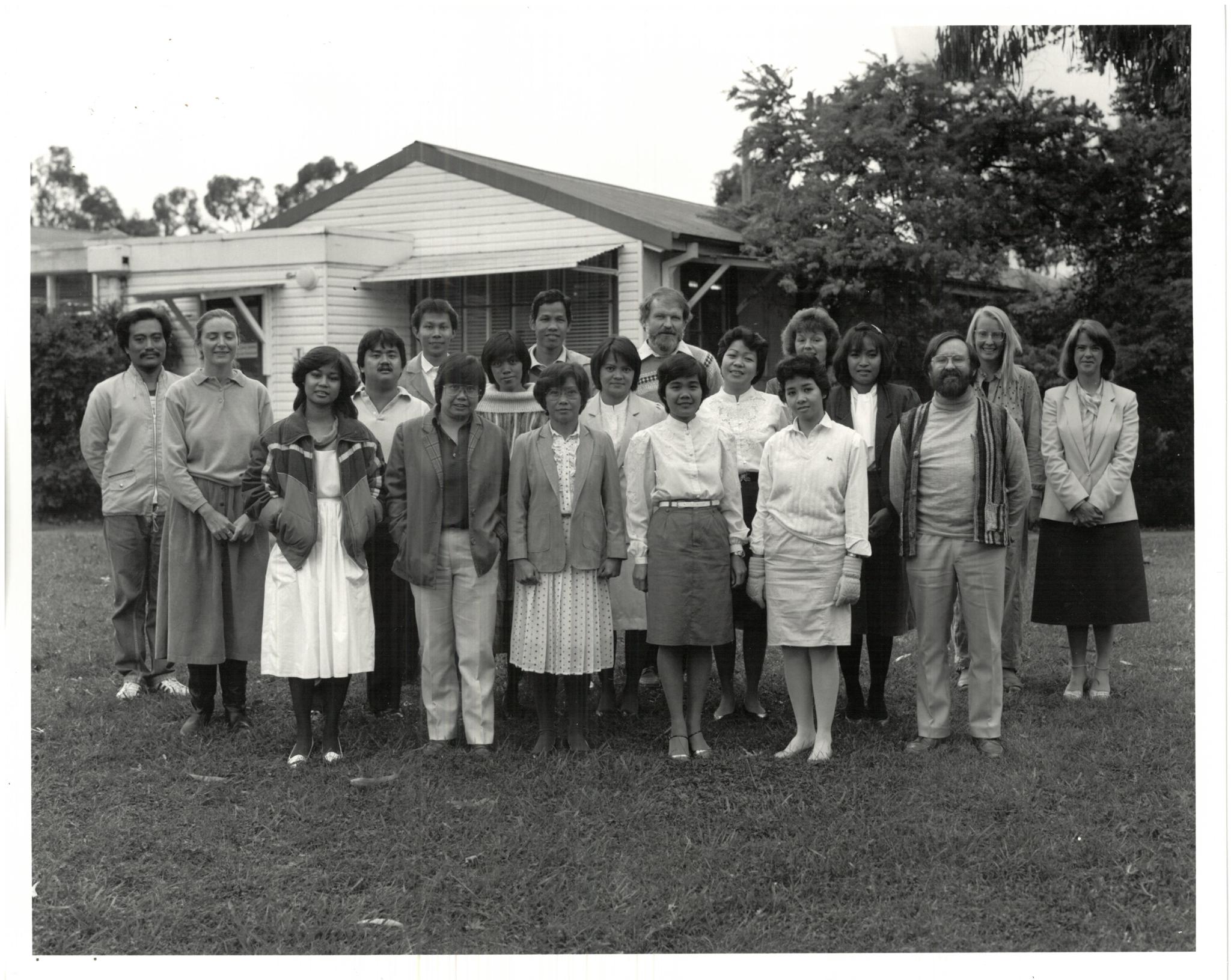
A group of NCDS students and staff in 1985
Crawford at 20: The name that connects generations

“His middle name is Crawford,” said a Master of Public Administration graduate at the 2024 Crawford student farewell ceremony, as she lifted her bow-tied baby towards Professor Janine O’Flynn, Director of the Crawford School of Public Policy.
For many, Crawford is the name of a school. For this mother, it means more. It’s a symbol of a community shaping her journey so much that she wanted her child to carry forward.
But the meaning behind Crawford goes back much further than the School’s name.
Before Crawford was the name
Long before the Crawford School was named such, its predecessors were already cultivating people who improve societies across the Asia-Pacific region.
One of those foundations was the National Centre of Development Studies (NCDS) at the Australian National University.
From the 1980s, NCDS offered programs in democracy, economics of development, and development administration, becoming a key academic destination for international students who would go on to influence policy in their countries. Honorary Associate Professor Suiwah Dean-Leung, who directed NCDS’ pioneering Economics of Development program recalls:
“It was an exciting time. We recruited the best international students. Most of them were with scholarships and from the Asia-Pacific area.”
Among them were 12 PhD students from Vietnam, who were supervised by Associate Professor Dean-Leung and jokingly called themselves the “NCDS mafia”. Many later worked with international organisations such as the Asian Development Bank and the International Monetary Fund, contributing to Vietnam’s economic transformation.
Around the same time, another influential stream was developing at the Australia-Japan Research Centre (AJRC). Led by Emeritus Professor Peter Drysdale, AJRC worked to build an open economy and more liberal trade policies across the Asia-Pacific region.
The work by researchers and students at AJRC helped lay the intellectual foundations for the Asia-Pacific Economic Cooperation (APEC) forum, while also contributing to early engagement around China’s economic opening, leading to China's participation in APEC.
Along with a strong international pivot, a third cornerstone was the Graduate Program in Public Policy (PPP), which commenced in 1985 and trained many public servants and supported their career advancement.
Over the years, PPP graduates have served across all levels of government in different policy portfolios, shaping and changing the public policy landscape across the region.
Although their focus differed, all these centres and programs shared a belief that knowledge should shape the world of policy practice and be passed down to the next generation of decision-makers and scholars.
Over time, these traditions came together to form the foundations of what would become the Crawford School of Public Policy.
Building a school around public policy
When Professor Andrew MacIntyre, Crawford’s Founding Director, arrived at ANU in 2002 after working at University of California San Diego, he saw an opportunity to bring these strengths together through a dedicated public policy school.
The vision was novel and ambitious: a place integrating research, education, and engagement with government to prepare future leaders for complex 21st-century challenges—from globalisation and climate change to changing models of governance.
“It takes time to build a vision that people could all sign into and an identity,” Emeritus Professor MacIntyre says.
That identity took shape in 2006, when the Crawford School of Economics and Government was established, named after Sir John Crawford, a leading public servant, scholar, and ANU leader, including terms as both Vice Chancellor and Chancellor
Six years later, the School became the Crawford School of Public Policy after major expansion provided the foundations for its broader focus on public policy.
While the School continued to evolve, its core remained focused on equipping current and future leaders with the knowledge, skills, and research capacity to shape better policies.
A community with lasting connections
Today, Crawford's influence extends beyond classrooms, with its alumni working in governments, international organisations, academia, and the private sector around the world.
But for many, what stays with them is not only what they learned at this School, but also the relationships they built from it.
“I love my work because I know what the students need,” says Ngan Le, who has worked in scholarships and recruitment at Crawford for over 20 years, “I understand the problems they face, as I myself was an international student.”
Known among students as the “minister of problem-solving”, Le and her team have supported students from their arrival through their graduation and beyond.
Even after students leave the school, the connection continues. Since 2024, the Crawford School has hosted regular Alumni Dialogues across Indonesia, Papua New Guinea, Vietnam, Cambodia, Laos, and Australia.
Alumni engagement activities as such, or Crawford’s "after-sales service", as Emeritus Professor MacIntyre puts it, bring together hundreds of alumni—many of whom are accomplished public servants and policymakers across the region—to exchange ideas and strengthen bonds.

Crawford School of Public Policy Alumni Dialogue event-Cambodia 2025
For Emerita Professor Kuntala Lahiri-Dutt, who has been working at Crawford since 2009, this focus on people is what defines the School.
“Crawford allows people to grow. It sees the individual’s potential, irrespective of whom that person is, whether a student or an academic. That's a really critical thing that an institution can do,” she says.
Peers in the region have started to keep up with Crawford’s way of shaping the future of public policy. During her visit to Singapore, former Crawford Director Professor Helen Sullivan, now Dean of the College of Asia and the Pacific, was told by colleagues from a local research school of public policy: “We closely follow what Crawford is doing—that's our benchmark.”
Few schools can inspire someone to name their child after them.
But perhaps Crawford is different: it’s not only a name, but a representation of decades of people teaching, learning, supporting each other, and carrying ideas and changes across borders.
For one graduate, it was a name worth passing on.