
Going home, going stronger: Javier Prisadi's journey from Indonesia to Crawford and back
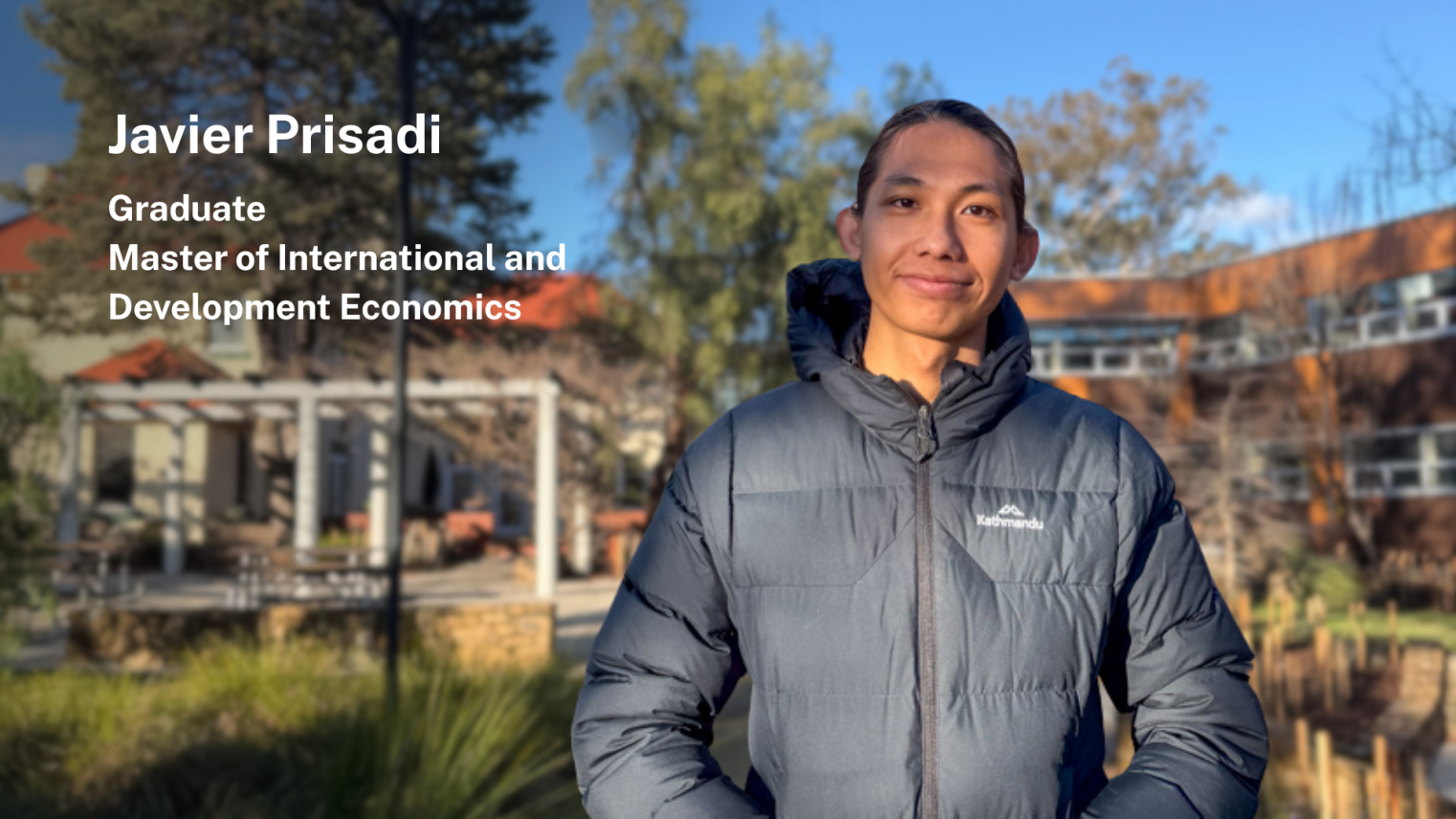
Javier Prisadi realised the importance of empirical economic research when working for the Indonesian government. Seeing disparities in Indonesia’s economic and social conditions sparked his interest in public policy long before he formally studied it.
Born in Makassar and raised in different parts of Indonesia, Javier experienced the country's diverse economic and social conditions first-hand. How development varied between regions and how public policy could shape people’s lives became dinner-table topics between him and his father.
Motivated by a desire to contribute to Indonesia's development, Javier studied at the Polytechnic of State Finance STAN (PKN STAN). He graduated with First Class Honours before joining the institution as a quality assurance officer.
Through his work, Javier became increasingly aware that tackling policy challenges requires not only practical experience, but also rigorous economic analysis supported by empirical research.
That realisation drove him to pursue a Master of International and Development Economics at the ANU Crawford School of Public policy.
“The Crawford School of Public Policy was a natural choice because of its strong reputation in public policy, development economics and applied economic research,” he said.
“Crawford offers an ideal environment where economics is closely connected to real-world policymaking, particularly within the Asia-Pacific region.”
His time at Crawford enabled him to think more critically about economic theory and examine real policy issues that he had always been interested in.
His classmates came from many different countries and professional backgrounds, bringing rich perspectives and cross-border contexts to their discussions.
“Our classroom discussions often reflected diverse policy perspectives and experiences, allowing me to appreciate how similar development challenges can be approached differently across countries,” he said.
Beyond the classroom, Javier actively engaged with the ANU Indonesia Project by attending and volunteering for its conference. There, he heard leading academics, policymakers and practitioners discuss the most pressing issues he had encountered in his own work in Indonesia.
For him, this experience allowed him to learn new perspectives and skills and reinforced Crawford’s role as a bridge between research and policymaking.
During his final year, Javier focused his research project on the economics of education, examining the relationship between overeducation and job satisfaction among Indonesian workers.
He found that although many countries are expanding access to higher education, ensuring graduates have skills aligned with labour market demand remains a global challenge.
“Understanding these common issues through rigorous economic analysis has strengthened my belief that effective policymaking should combine local knowledge with international evidence,” he said.
Substantially supported by the Indonesian government through his education and career, Javier feels a strong responsibility to give back.
Now working in the Indonesian Ministry of Finance, he brings in new knowledge, analytical tools and perspectives he developed during his time at Crawford to serve his people.
Looking ahead, he hopes to pursue a PhD and build a career that combines public service, research and higher education to contribute to Indonesia's long-term development.
For prospective students, Javier encourages them to ask questions, learn from peers and choose research topics that genuinely interest them and connect to real policy challenges.
“Crawford provides an incredibly supportive learning environment where faculty members genuinely want students to succeed.”
Javier, Crawford will always be your academic home. We wish you every success as you work to make better evidence-based policy and improve public policy performance.
Learn more about Master of International and Development Economics