
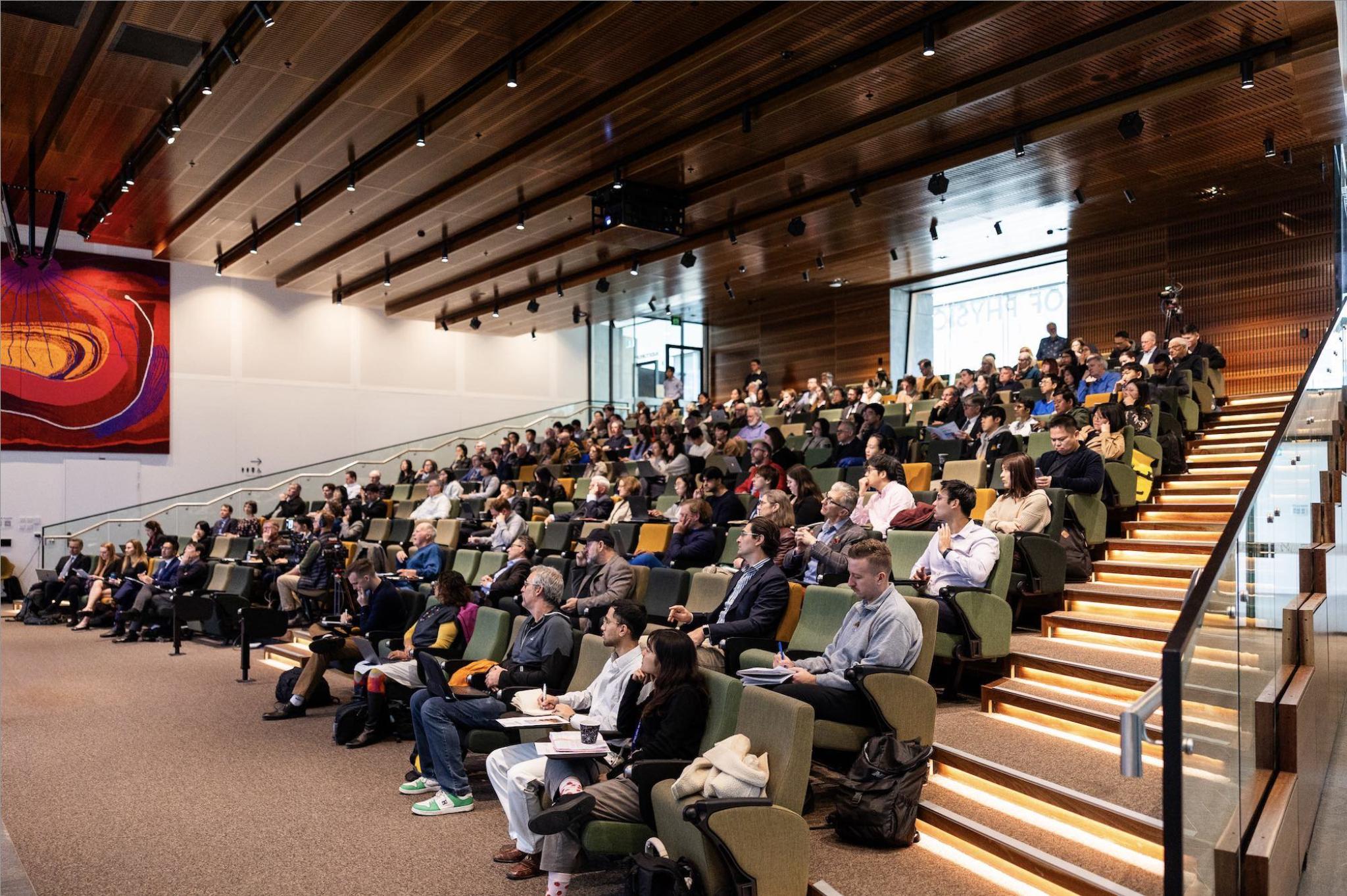
The Japan Update 2026 was held by the Australia-Japan Research Centre and the ANU Japan Institute online and in-person on Wednesday 9 September 2026.
Marking the 50th anniversary of the Basic Treaty of Friendship and Cooperation between Australia and Japan, this year’s Update brought together experts from Australia and Japan to provide insights into Japan’s economy, politics and foreign policy, reflect on the state of Japan studies in Australia, and discuss the past and future of the bilateral relationship.
Livestream
https://vimeo.com/event/6158365/73b8ccf1ae
Japan Update 2026 Summary
Welcome and Introduction
Shiro Armstrong, Director, Australia-Japan Research Centre, The Australian National University
Rebekah Brown, Interim Vice-Chancellor, The Australian National University
The 2026 Japan Update marked the 50th anniversary of the Basic Treaty of Friendship and Cooperation between Australia and Japan, commonly known as the NARA Treaty. The anniversary provided an opportunity to reflect on how the bilateral relationship has developed over the past half-century, and to consider where it is heading. Under the theme of Japan’s ‘normalisation’, the conference examined the economic, political and strategic changes shaping Japan and their implications for Australia and the wider region.
Shiro Armstrong, Director of the Australia-Japan Research Centre, welcomed participants to Japan Update 2026, hosted by the Centre together with the ANU Japan Institute. ANU Interim Vice-Chancellor Rebekah Brown situated the Japan Update within the University’s longstanding commitment to understanding Australia’s region, a purpose that has been central to ANU since its establishment in 1946. She described the depth of Japan expertise at ANU and the exchange of ideas fostered through events such as the Japan Update as an important part of putting that regional mission into practice.
Reflecting on the significance of the NARA Treaty, Brown noted that the Australia–Japan relationship has grown from its foundations in trade into a much broader partnership encompassing security, energy, science, technology and people-to-people ties. She framed the anniversary as a moment to consider what will come next for both countries before introducing Minister for Industry and Innovation and Minister for Science Tim Ayres to deliver the opening keynote.
Opening Keynote
Tim Ayres, Minister for Industry and Innovation and Minister for Science
In the opening keynote, Minister Tim Ayres considered how the Australia–Japan relationship can respond to the changing international economic and strategic environment. He reflected on the evolution of the bilateral economic relationship, noting that Australia and Japan have long benefited from complementary economic strengths, including Japanese investment and manufacturing expertise, alongside Australia’s role as a reliable supplier of energy and resources. He argued that as the international trading system has become less certain, the next phase of the Australia–Japan relationship would be shaped by the convergence of industrial policy, energy security, technology and national resilience, while the two countries transform their industrial and energy systems, creating new opportunities for closer cooperation.
Building on the longstanding complementarity between Australian resources and Japanese industry, Ayres presented closer coordination between the two countries’ industrial strategies as central to that transformation. Australia’s advantages in resources, renewable energy and proximity to Asian markets create opportunities in areas such as green iron and steel processing, which would greatly reduce Japan’s energy requirements and carbon emissions while building new productive capacity in Australia. He stressed that this transition would require governments to build capabilities that went beyond the more market-oriented policy settings of recent decades, while avoiding a retreat into protectionism.
Building on the longstanding complementarity between Australian resources and Japanese industry, Ayres pointed to emerging opportunities in green iron and steel processing in Australia, critical minerals, quantum technology and cyber security. He argued that Australia’s resource and renewable-energy advantages and Japan’s industrial and technological capabilities provide a strong basis for a deeper partnership through the coming decades.
Vote of Thanks
Kazuhiro Suzuki, Japanese Ambassador to Australia
Following Minister Ayres’ keynote, Ambassador Kazuhiro Suzuki reflected on the NARA Treaty as the foundation for the modern, multidimensional Australia–Japan relationship. He noted how cooperation has expanded beyond its economic foundations into areas including politics, science, technology and culture, supported by strong public trust and increasingly close strategic ties.
Ambassador Suzuki highlighted the diversification of Japanese investment in Australia beyond resources and energy into sectors such as finance, housing, logistics, retail and food. Looking to the future, he identified advanced technology as an important new frontier for the relationship, with opportunities in AI, quantum, space, critical minerals, defence and infrastructure. He cited the Memorandum of Cooperation on Quantum Science, Technology, and Innovation, signed by Minister Tim Ayres and Japan’s Minister of State for Science and Technology Policy, Kimi Onoda, on 27 July as an example of how longstanding trust is being translated into new forms of practical cooperation.
The New Normal in Japan’s Economy
Keynote
Koji Nakamura, Bank of Japan
Koji Nakamura examined whether Japan may be entering a new economic era after three decades of weak growth, low inflation and unconventional monetary policy following the collapse of the asset-price bubble. Japan is now experiencing sustained inflation, rising wages and strong corporate investment, with robust AI-related global demand also supporting exports and activity in parts of the corporate sector. These developments point to a shift away from the deflationary conditions that characterised much of the past three decades. At the same time, demographic decline continues to constrain its longer-term growth potential.
Nakamura highlighted labour market pressures as an important feature of Japan’s economic condition, with labour shortages increasingly structural rather than cyclical, creating continued upward pressure on wages and prices in Japan. For the Bank of Japan, the challenge is determining how much of this change is lasting. Temporary shocks from food, energy and import prices can push inflation higher without necessarily changing its underlying trend, while estimating the economy’s underlying capacity and the appropriate level of interest rates remains difficult. Financial conditions are tightening but remain supportive as the Bank gradually normalises monetary policy, while assessing whether underlying inflation will stabilise around 2 per cent.
Discussion
Chair: Ippei Fujiwara, University of Tokyo and Keio University
Discussant: Katrina Di Marco, Deputy Secretary, Treasury
Katrina Di Marco broadened the discussion from monetary policy to the fiscal pressures confronting Japan and other advanced economies. Ageing populations, demand for productivity-enhancing investment and infrastructure, and growing spending on defence and economic security are increasing demands on government budgets at the same time as sovereign borrowing costs are rising.
These pressures are particularly significant for Japan given its high public debt and the large share of government spending already committed to social security and debt servicing. She highlighted recent changes in Japan’s fiscal framework that place greater emphasis on longer-term debt sustainability and multi-year strategic investment, including in areas such as AI, semiconductors and energy security. Under the new approach, funding for strategic projects can be committed over a longer horizon rather than allocated largely on a year-by-year basis.
Di Marco identified the central test as whether Japan can move from growth supported heavily by monetary policy towards investment-led growth without undermining fiscal credibility or driving a sustained increase in borrowing costs.
Foreign Policy and Political Choices
Chair: Lauren Richardson, The Australian National University
Yves Tiberghien, University of British Columbia and Taipei School of Economics and Political Science
Naoko Eto, Gakushuin University
Tomohiko Satake, Aoyama Gakuin University
The foreign policy panel examined the increasingly difficult choices Japan faces as the United States becomes more transactional, strategic competition with China intensifies and the international economic order comes under pressure. The discussion explored how Japan can maintain its US alliance while preserving economic engagement with China, strengthening other partnerships and supporting multilateral institutions.
Tomohiko Satake argued that traditional labels such as ‘balancing’, ‘bandwagoning’ or ‘hedging’ no longer adequately describe Japan’s strategy. He characterised it instead as increasingly multi-layered: strengthening the US alliance while expanding partnerships with countries including Australia, India and European states, and maintaining engagement with China where interests overlap. Naoko Eto emphasised the parallel challenge of maintaining deterrence while rebuilding political dialogue with China, as well as the importance of developing a clearer strategic narrative for the region.
Yves Tiberghien focused on the significant pressures created by US tariffs and Japan’s economic accommodation of Washington, including a commitment to invest US$550 billion in the United States by 2028 in exchange for a reduced tariff rate of 15 per cent. He also cautioned against allowing economic security to become so expansive that it accelerates economic fragmentation. The broader discussion highlighted the importance of combining credible deterrence with diplomacy, multilateral cooperation and stronger middle-power partnerships.
The State of Japanese Studies in Australia
Keynote
Sawako Shirahase, University of Tokyo
Sawako Shirahase challenged the idea of Japanese studies as simply the study of Japan as a distinctive national case. She argued that Japan can instead provide valuable comparative insights into challenges increasingly shared across advanced societies, including demographic ageing, changing labour markets, generational inequality, migration, welfare sustainability and gender disparities. Rather than one country studying the other, she proposed a model in which Australian and Japanese researchers jointly investigate shared challenges.
This approach would place Japanese studies more firmly within comparative social science while retaining the language, cultural and historical knowledge that gives the field its depth. Shirahase argued for stronger methodological training and greater bilateral research collaboration in areas that currently receive less attention than science and technology, including labour, political economy, welfare, generational change and gender.
Discussion
Chair: Simon Avenell, The Australian National University
Kent Anderson, The Australian National University
Carolyn Stevens, Monash University
The panel considered a paradox suggested by Kent Anderson in Australian engagement with Japan: familiarity with Japan may be broader than ever, but the pipeline of people with deep language, disciplinary and country expertise has weakened. Changes within universities, falling enrolments in areas like Asian studies and the retirement of many established specialists have raised questions about how the next generation of Japan expertise will be developed.
Carolyn Stevens drew on developments in university teaching and academic publishing to highlight pressures on the research pipeline and the changing international composition of Japanese studies. She also noted that AI tools can lower some barriers to participation in the field but may produce work that appears polished but overlooks important Japanese-language scholarship and context.
Kent Anderson argued that the policy challenge has shifted from building mass ‘Asia literacy’ towards sustaining a smaller cohort of deeper expertise. AI translation tools reduce some of the practical upfront incentives for committing years to language study, despite advanced research and professional relationships still requiring substantial language and cultural knowledge. He suggested that future policy may therefore need to concentrate resources on intensive language training, extended in-country experience and centres of excellence capable of sustaining advanced expertise.
The Next 50 Years of the Australia–Japan Relationship
Keynote
Peter Drysdale, The Australian National University
Peter Drysdale used the history of the NARA Treaty to consider the principles that should guide Australia–Japan relations over the next 50 years. He noted that the treaty went beyond the consolidation of bilateral trade by extending equal treatment to investment and the movement of people. This created the confidence needed for long-term resource and energy investment and helped reposition Australia economically and politically in Asia. Drysdale contended that the treaty’s emphasis on equality, non-discrimination and deeper economic engagement remains relevant to two major contemporary challenges: the transition to a green industrial economy and the changing role of the United States in the regional and global order.
Drysdale argued that the next phase of Australia–Japan economic complementarity will need to move beyond the traditional resources and energy relationship towards trade in renewable energy embodied in products such as green iron and steel. As with the development of earlier resources and LNG trade, this transformation will require deliberate institution-building and sustained cooperation between governments and industry rather than relying on market forces alone.
He also argued that their respective alliances with the United States remainremain important but cannot provide the entire framework for Australian and Japanese economic and political security. The principles underpinning the NARA Treaty could instead help inform wider regional arrangements that strengthen interdependence, preserve non-discrimination and engage China as an integral part of the regional economy.
Discussion
Chair: Geraldine Doogue, Australian Broadcasting Corporation
Kate Kitagawa, La Trobe University
Shiro Armstrong, The Australian National University
Melissa Conley Tyler, The University of Melbourne
The final panel explored how Australia and Japan might translate the broad principles of the relationship into new areas of cooperation amid considerable uncertainty about the international order. Kate Kitagawa identified space as an important emerging field, arguing that cooperation increasingly needs to extend beyond established economic and security domains towards co-creation in areas where the rules and institutions are still being developed.
Melissa Conley Tyler used a series of contrasting scenarios, including conflict, competing economic blocs, continuing geopolitical uncertainty and a possible US–China accommodation, to illustrate how dramatically the environment for the bilateral relationship could change. The scenarios also highlighted the importance of domestic political stability in both countries and the opportunities that periods of turbulence may create for middle powers to shape new forms of cooperation.
Shiro Armstrong argued that fragmentation into competing blocs is not inevitable and that Australia, Japan and other middle powers retain agency to shape regional outcomes. He emphasised cooperation with Southeast Asia, equal treatment and non-discrimination as ways of preserving strategic choice rather than forcing countries to take sides. The green transition emerged as one practical area in which Australia and Japan could pursue positive-sum cooperation while helping to strengthen a more open regional order.
Closing and Thank You
Ippei Fujiwara, University of Tokyo and Keio University
Simon Avenell, Director, Japan Institute, The Australian National University
The conference closed with thanks to the speakers, organisers and participants, and reflections on the breadth of discussion across the day. Ippei Fujiwara and Simon Avenell announced that the next Japan Update would be held in early September, 2027.