
Outcome: June 2026

Inflation Persists while Economic Momentum Fades: Shadow Board Recommends No Rate Change

Australia’s latest inflation data are still cause for concern. The Consumer Price Index rose 4.2% over the year to April, down from 4.6% in March but still well above the Reserve Bank’s 2–3% target band. More importantly, trimmed-mean inflation edged up from 3.3% to 3.4%. The legacy quarterly measures tell a similar story: on the pre-October 2025 quarterly-collection basis, headline inflation was 4.1% and trimmed-mean inflation 3.5% over the year to the March quarter. The decline in monthly headline inflation partly reflected a 7.0% fall in automotive fuel prices, resulting from the temporary reduction in fuel excise and lower fuel-import prices, although fuel remained 18.6% more expensive than a year earlier. Non-tradables inflation increased to 4.7% and housing costs rose 6.3%. Electricity prices were 22.5% higher, largely because government rebates had expired, while new-dwelling prices rose 4.7% and medical and hospital services 4.9%, indicating that domestic price pressures extend beyond imported energy. At the same time, real GDP growth slowed to 0.3% in the March quarter and unemployment increased, leading to an uncomfortable combination: the Australian economy is losing momentum, but underlying inflation remains too high. Consequently, the RBA Shadow Board recommends the cash rate be kept on hold, attaching a 60% probability that this is the optimal decision.

Labour-market conditions softened in April. Seasonally adjusted employment fell by 18,600, with declines in both full-time and part-time work, while the employment-to-population ratio fell from 63.9% to 63.7%. The unemployment rate rose from 4.3% to 4.5% and the participation rate edged down to 66.7%. Underemployment, however, declined slightly to 5.8%, and monthly hours worked increased by 0.8%, suggesting that the deterioration was not uniform. The less volatile trend estimates were also firmer, showing employment increasing by around 22,000 and unemployment holding at 4.3%. Forward indicators remain mixed: ANZ–Indeed job advertisements rose 1.8% in May, partly reversing falls over the previous two months, and were 2.0% higher than a year earlier. Wage growth has continued to moderate, with the Wage Price Index increasing by 0.8% in the March quarter and 3.3% over the year. Nominal wage growth is now below headline inflation and approximately in line with trimmed-mean inflation. Overall, labour demand is easing, but the data do not yet point to a rapid accumulation of spare capacity.

The Australian dollar traded at around US$0.70 in mid-June, with the trade-weighted index at 65.6, having retreated from the levels reached in May as global risk sentiment and commodity prices fluctuated. Australian government bond yields remain elevated. In the latest available readings, the 1-year yield was approximately 4.54%, the 2-year yield 4.45%, the 5-year yield 4.48% and the 10-year yield 4.82%. The yield curve is therefore mildly inverted at the short end, with the 2-year minus 1-year spread close to -9 basis points, almost flat between two and five years, and clearly upward sloping thereafter, with the 10-year minus 2-year spread around 37 basis points. This configuration is consistent with markets expecting monetary policy to remain restrictive in the near term, while assigning a sizeable inflation and term premium to longer-dated debt. Equity prices have nevertheless remained resilient. The S&P/ASX 200 closed at approximately 8,804 on 12 June, rising almost 2% during the session as hopes of a de-escalation in the Middle East supported global risk markets. Financial conditions remain highly sensitive to geopolitical news and the outlook for energy prices.

Household indicators have weakened further. The Westpac–Melbourne Institute Consumer Sentiment Index fell 2.9% in June to 80.6, leaving pessimists heavily outnumbering optimists. Assessments of family finances and the longer-term economic outlook deteriorated, while the index measuring whether it is a good time to purchase a major household item remained exceptionally weak. Actual spending has also begun to soften. The ABS Monthly Household Spending Indicator fell by 1.1% in April, seasonally adjusted, after increasing strongly in March, although nominal expenditure remained 4.9% higher than a year earlier. Spending declined across both goods and services, with particularly large falls in transport, clothing and food. Credit growth remains much stronger: total private-sector credit rose 0.7% in April and 8.0% over the year, reflecting continued growth in housing and business lending. The May federal budget’s fiscal impulse appears slightly expansionary, although the weakening in confidence and spending suggests that households remain highly sensitive to further increases in interest rates, unemployment or living costs.

Business surveys describe an economy facing weaker demand, coupled with continuing cost pressure. NAB’s business conditions index was unchanged at +3 in May, below its long-run average, while business confidence recovered from -23 to -14 but remained deeply negative across most industries. Profitability was the weakest component relative to its long-run average. Measures of capacity utilisation point to increasing slack, although their levels differ because they cover different samples: NAB’s broad non-farm business measure fell to 81.9%, still slightly above its long-run average, while the Ai Group measure for Australian industry fell from 77.7% to 75.7%, below its long-term range of 77–82%. The Purchasing Managers’ Indices also softened: the composite index fell to 48.7 in May, below the threshold separating expansion from contraction. The manufacturing PMI remained marginally positive at 50.7, but manufacturing output contracted for a fourth consecutive month. Services activity and new business declined. The Ai Group Australian Industry Index fell to -26.5, with firms reporting weak new orders, deferred investment and continued disruption from high energy and freight costs. Cost growth eased from its April spike but remains elevated, while weak demand is limiting firms’ ability to pass higher input costs fully into final prices. The business sector is therefore displaying an uncomfortable combination of subdued confidence, declining activity and persistent cost pressure.

The global outlook has weakened materially following the conflict in the Middle East and the associated disruption to energy production, trade and international shipping. In its June Economic Outlook, the OECD projects global growth of 2.8% in 2026 and 3.1% in 2027 under its “time-limited disruption” scenario, which assumes a lasting resolution of the conflict and a progressive restoration of Gulf energy production and trade from mid-2026. G20 inflation is projected to rise from 3.4% in 2025 to 4.0% this year before easing to 3.1% in 2027. Under the OECD’s prolonged-disruption scenario, global growth falls to 2.1% in 2026 and 1.8% in 2027. The World Bank is similarly cautious, forecasting global growth of 2.5% this year and warning that it could fall to 1.3% if more severe energy-supply disruption were accompanied by substantial financial-market stress. The World Economic Forum’s May survey found that 89% of chief economists expect global growth to weaken over the coming year and 94% expect inflation to increase, principally because of higher energy and food prices. For Australia, higher energy export earnings may provide some support to national income, but households and businesses still face higher fuel, freight and other input costs, while weaker global growth is likely to weigh on external demand. The RBA can reasonably look through the first-round effect of an energy shock, but doing so becomes more difficult when underlying inflation is already above target and domestic firms are reporting broader cost pass-through. On the other hand, as argued above, softer growth, falling confidence and a cooling labour market argue against responding mechanically to every increase in headline inflation.

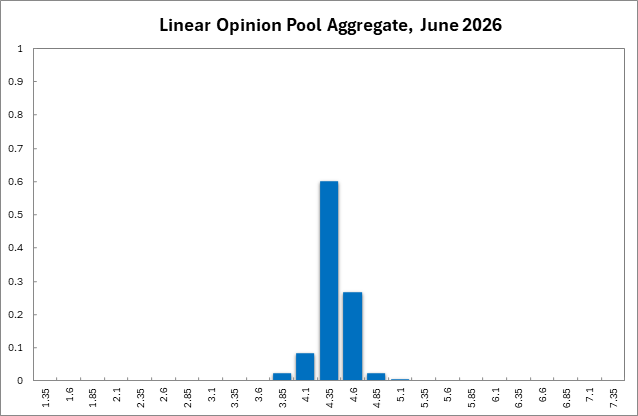
The Shadow Board assigns a 60% probability that holding the overnight rate at 4.35% is optimal, an 11% probability that reducing the overnight rate to 4.10% is appropriate, and a 29% probability that raising the rate above 4.35% is called for. The mode recommendation is for a rate hold, but the Shadow Board’s perceived inflation risks clearly reside on the upside.

Six months out, the Board attaches a 30% probability that the current cash rate is optimal, a 35% probability that the cash rate should be lower than the current setting of 4.35%, and a 35% probability that a higher rate is required. The mode (with a confidence probability of 30%) is for the overnight right to be at 4.35%. At the 12-month horizon, probabilities are 16% for a rate hold, 54% for a lower interest rate, and 30% for a higher rate. Three years out, the Board attaches a 78% probability of a lower rate being optimal, 7% to the current setting, and 15% to a higher rate.

The distribution for the current recommendation is unchanged, ranging from 3.85%–5.10%. For the 6-month horizon, the distribution widened marginally, to 3.60%–5.35%. The distributions for the 12-month and 3-year horizons also widened slightly, to 0.85%–5.60% and 0.85%-5.85%, respectively.

Aggregate

    Current
    Aggregate
    Aggregate
    Aggregate
    Aggregate

    Inflation Persists while Economic Momentum Fades: Shadow Board Recommends No Rate Change

    Australia’s latest inflation data are still cause for concern. The Consumer Price Index rose 4.2% over the year to April, down from 4.6% in March but still well above the Reserve Bank’s 2–3% target band. More importantly, trimmed-mean inflation edged up from 3.3% to 3.4%. The legacy quarterly measures tell a similar story: on the pre-October 2025 quarterly-collection basis, headline inflation was 4.1% and trimmed-mean inflation 3.5% over the year to the March quarter. The decline in monthly headline inflation partly reflected a 7.0% fall in automotive fuel prices, resulting from the temporary reduction in fuel excise and lower fuel-import prices, although fuel remained 18.6% more expensive than a year earlier. Non-tradables inflation increased to 4.7% and housing costs rose 6.3%. Electricity prices were 22.5% higher, largely because government rebates had expired, while new-dwelling prices rose 4.7% and medical and hospital services 4.9%, indicating that domestic price pressures extend beyond imported energy. At the same time, real GDP growth slowed to 0.3% in the March quarter and unemployment increased, leading to an uncomfortable combination: the Australian economy is losing momentum, but underlying inflation remains too high. Consequently, the RBA Shadow Board recommends the cash rate be kept on hold, attaching a 60% probability that this is the optimal decision.

    Labour-market conditions softened in April. Seasonally adjusted employment fell by 18,600, with declines in both full-time and part-time work, while the employment-to-population ratio fell from 63.9% to 63.7%. The unemployment rate rose from 4.3% to 4.5% and the participation rate edged down to 66.7%. Underemployment, however, declined slightly to 5.8%, and monthly hours worked increased by 0.8%, suggesting that the deterioration was not uniform. The less volatile trend estimates were also firmer, showing employment increasing by around 22,000 and unemployment holding at 4.3%. Forward indicators remain mixed: ANZ–Indeed job advertisements rose 1.8% in May, partly reversing falls over the previous two months, and were 2.0% higher than a year earlier. Wage growth has continued to moderate, with the Wage Price Index increasing by 0.8% in the March quarter and 3.3% over the year. Nominal wage growth is now below headline inflation and approximately in line with trimmed-mean inflation. Overall, labour demand is easing, but the data do not yet point to a rapid accumulation of spare capacity.

    The Australian dollar traded at around US$0.70 in mid-June, with the trade-weighted index at 65.6, having retreated from the levels reached in May as global risk sentiment and commodity prices fluctuated. Australian government bond yields remain elevated. In the latest available readings, the 1-year yield was approximately 4.54%, the 2-year yield 4.45%, the 5-year yield 4.48% and the 10-year yield 4.82%. The yield curve is therefore mildly inverted at the short end, with the 2-year minus 1-year spread close to -9 basis points, almost flat between two and five years, and clearly upward sloping thereafter, with the 10-year minus 2-year spread around 37 basis points. This configuration is consistent with markets expecting monetary policy to remain restrictive in the near term, while assigning a sizeable inflation and term premium to longer-dated debt. Equity prices have nevertheless remained resilient. The S&P/ASX 200 closed at approximately 8,804 on 12 June, rising almost 2% during the session as hopes of a de-escalation in the Middle East supported global risk markets. Financial conditions remain highly sensitive to geopolitical news and the outlook for energy prices.

    Household indicators have weakened further. The Westpac–Melbourne Institute Consumer Sentiment Index fell 2.9% in June to 80.6, leaving pessimists heavily outnumbering optimists. Assessments of family finances and the longer-term economic outlook deteriorated, while the index measuring whether it is a good time to purchase a major household item remained exceptionally weak. Actual spending has also begun to soften. The ABS Monthly Household Spending Indicator fell by 1.1% in April, seasonally adjusted, after increasing strongly in March, although nominal expenditure remained 4.9% higher than a year earlier. Spending declined across both goods and services, with particularly large falls in transport, clothing and food. Credit growth remains much stronger: total private-sector credit rose 0.7% in April and 8.0% over the year, reflecting continued growth in housing and business lending. The May federal budget’s fiscal impulse appears slightly expansionary, although the weakening in confidence and spending suggests that households remain highly sensitive to further increases in interest rates, unemployment or living costs.

    Business surveys describe an economy facing weaker demand, coupled with continuing cost pressure. NAB’s business conditions index was unchanged at +3 in May, below its long-run average, while business confidence recovered from -23 to -14 but remained deeply negative across most industries. Profitability was the weakest component relative to its long-run average. Measures of capacity utilisation point to increasing slack, although their levels differ because they cover different samples: NAB’s broad non-farm business measure fell to 81.9%, still slightly above its long-run average, while the Ai Group measure for Australian industry fell from 77.7% to 75.7%, below its long-term range of 77–82%. The Purchasing Managers’ Indices also softened: the composite index fell to 48.7 in May, below the threshold separating expansion from contraction. The manufacturing PMI remained marginally positive at 50.7, but manufacturing output contracted for a fourth consecutive month. Services activity and new business declined. The Ai Group Australian Industry Index fell to -26.5, with firms reporting weak new orders, deferred investment and continued disruption from high energy and freight costs. Cost growth eased from its April spike but remains elevated, while weak demand is limiting firms’ ability to pass higher input costs fully into final prices. The business sector is therefore displaying an uncomfortable combination of subdued confidence, declining activity and persistent cost pressure.

    The global outlook has weakened materially following the conflict in the Middle East and the associated disruption to energy production, trade and international shipping. In its June Economic Outlook, the OECD projects global growth of 2.8% in 2026 and 3.1% in 2027 under its “time-limited disruption” scenario, which assumes a lasting resolution of the conflict and a progressive restoration of Gulf energy production and trade from mid-2026. G20 inflation is projected to rise from 3.4% in 2025 to 4.0% this year before easing to 3.1% in 2027. Under the OECD’s prolonged-disruption scenario, global growth falls to 2.1% in 2026 and 1.8% in 2027. The World Bank is similarly cautious, forecasting global growth of 2.5% this year and warning that it could fall to 1.3% if more severe energy-supply disruption were accompanied by substantial financial-market stress. The World Economic Forum’s May survey found that 89% of chief economists expect global growth to weaken over the coming year and 94% expect inflation to increase, principally because of higher energy and food prices. For Australia, higher energy export earnings may provide some support to national income, but households and businesses still face higher fuel, freight and other input costs, while weaker global growth is likely to weigh on external demand. The RBA can reasonably look through the first-round effect of an energy shock, but doing so becomes more difficult when underlying inflation is already above target and domestic firms are reporting broader cost pass-through. On the other hand, as argued above, softer growth, falling confidence and a cooling labour market argue against responding mechanically to every increase in headline inflation.

    The Shadow Board assigns a 60% probability that holding the overnight rate at 4.35% is optimal, an 11% probability that reducing the overnight rate to 4.10% is appropriate, and a 29% probability that raising the rate above 4.35% is called for. The mode recommendation is for a rate hold, but the Shadow Board’s perceived inflation risks clearly reside on the upside.

    Six months out, the Board attaches a 30% probability that the current cash rate is optimal, a 35% probability that the cash rate should be lower than the current setting of 4.35%, and a 35% probability that a higher rate is required. The mode (with a confidence probability of 30%) is for the overnight right to be at 4.35%. At the 12-month horizon, probabilities are 16% for a rate hold, 54% for a lower interest rate, and 30% for a higher rate. Three years out, the Board attaches a 78% probability of a lower rate being optimal, 7% to the current setting, and 15% to a higher rate.

    The distribution for the current recommendation is unchanged, ranging from 3.85%–5.10%. For the 6-month horizon, the distribution widened marginally, to 3.60%–5.35%. The distributions for the 12-month and 3-year horizons also widened slightly, to 0.85%–5.60% and 0.85%-5.85%, respectively.

    Sally Auld

      Current
      Sally Auld
      Sally Auld
      Sally Auld
      Sally Auld

      No comment.

      Besa Deda

        Current
        Besa Deda
        Besa Deda
        Besa Deda
        Besa Deda

        No comment.

        Begoña Domínguez

          Current
          Begoña Domínguez
          Begoña Domínguez
          Begoña Domínguez
          Begoña Domínguez

          No comment.

          Mei Dong

            Current
            Mei Dong
            Mei Dong
            Mei Dong
            Mei Dong

            No comment.

            Stella Huangfu

              Current
              Stella Huangfu
              Stella Huangfu
              Stella Huangfu
              Stella Huangfu

              In my view, the RBA should leave the cash rate unchanged at its meeting next week. The Bank has already raised interest rates three times this year, and it should now allow time to assess the cumulative effects of those increases, which operate with a lag. The latest GDP figures were also weaker than expected, suggesting that economic activity is softening. Together, these factors support a pause rather than another rate increase.

              Mariano Kulish

                Current
                Mariano Kulish
                Mariano Kulish
                Mariano Kulish
                Mariano Kulish

                Recent data reinforce my concern, expressed at the previous meeting, that the stance of policy is not yet sufficiently restrictive. Even measured against underlying inflation — the trimmed mean and weighted median both stood at 3.5 per cent in the March quarter — the real cash rate is only around 0.85 per cent; measured against headline inflation it is close to zero. On most estimates this places the stance at or below neutral, rather than in clearly contractionary territory. After a period in which inflation has remained outside the target band for the better part of five years, a stance that is at best marginally restrictive is unlikely to be a force that returns inflation to target within a reasonable horizon.

                Underlying inflation has not eased and short-term inflation expectations have edged higher. The geopolitical tensions I noted previously have persisted, and the central risk remains that a prolonged period above target becomes embedded in long-run inflation expectations and wage-setting behaviour — rather than the first-round energy price impulse itself, which monetary policy can reasonably look through.

                Activity has slowed and the labour market has begun to soften, and these developments warrant genuine weight. But much of the weakness in growth reflects persistently soft productivity — a longstanding structural problem rather than a consequence of the increases in the cash rate — and should not be read as evidence of monetary over-tightening. More fundamentally, a slowdown in economic activity that results from the central bank's efforts to stabilise inflation is not a cost to be apologised for; it is precisely what cements the framework's long-run credibility. Waiting and assessing, in the hope that inflation returns to the band of its own accord, stabilises inflation only by luck and does nothing to anchor expectations. Precisely because the real cash rate is close to neutral, the marginal cost of a further increment is modest; and because inflation has been outside the band for most of the last five years, I would argue that the balance of risks currently favours price stability. Should tightening prove excessive and inflation move toward or below the lower bound of the band, the Board retains clear scope to ease. The more serious risk is that a fifth consecutive year outside the band erodes confidence in the target.

                In this context, what concerns me is how the last statement was received. The Board framed policy as "well placed to respond to developments" and emphasised its attentiveness to incoming data; market commentary promptly read this as a signal that there was now scope to pause, with some major-bank economists moving to expect no further tightening this year. This is the heart of the problem, because monetary transmission operates through the expected path of the cash rate: financial conditions are determined not by the current rate alone but by the path markets anticipate. A communication received as a readiness to wait therefore flattens that expected path and eases financial conditions, partially offsetting the tightening already delivered and leaving policy persistently reactive to inflation outcomes rather than getting ahead of them. The Board should instead make clear that it intends to remain on a tightening path until there is sustained and demonstrable evidence that inflation is returning to target — not a forecast that it will, but the realisation in the data. I therefore recommend that the cash rate be increased by 25 basis points to 4.60 per cent at the next meeting, accompanied by an explicit commitment to continue tightening until that evidence is in hand.

                Warwick McKibbin

                  Current
                  Warwick McKibbin
                  Warwick McKibbin
                  Warwick McKibbin
                  Warwick McKibbin

                  No comment.

                  John Romalis

                    Current
                    John Romalis
                    John Romalis
                    John Romalis
                    John Romalis

                    No comment.

                    Peter Tulip

                      Current
                      Peter Tulip
                      Peter Tulip
                      Peter Tulip
                      Peter Tulip

                      No comment.

                      Past Outcomes